Paver driveways built on a base made for wheels
Paver driveways take a load a patio never sees, so every paver driveway installation in Ventura County that VC Turf builds starts with a deeper base, fabric where the soil calls for it, and a pattern that locks under a turning tire. The surface stays flat, drains to the street, and can be opened and reset if the ground ever moves.
What changes under the pavers when the load gets heavier
Choose what will park on the driveway and the cross-section changes with it. The layer names are what matter; depths are set at your estimate after we check the soil.
A daily-driver driveway
Base rock in compacted lifts over the native soil, with geotextile where the ground is clay or loose sand. Driveway-grade pavers on a screeded sand bed, held by edge restraint on every open side. Enough for family cars, an SUV, and the delivery van at the garage.
Built for a work truck, a trailer, or a motorhome
The excavation goes deeper and the base rock goes in as more lifts, each compacted on its own. Geotextile goes down regardless of soil, because the weight concentrates at the axle spots where a vehicle sits for weeks. The pavers are the thicker driveway grade, and the apron restraint gets extra spikes where a trailer swings in.
Why a driveway base is not a patio base with more rock
A patio carries people and furniture, spread out and standing still. A driveway carries a car that stops, starts, and turns on the same few square feet every day. When a front tire pivots at the apron it shoves the pavers sideways, and a base that was fine under a dining table starts to rut. So the driveway gets a deeper excavation, base rock in more lifts, and geotextile under the rock on soft or clay ground. A paver patio can sit on a lighter base; a driveway cannot.
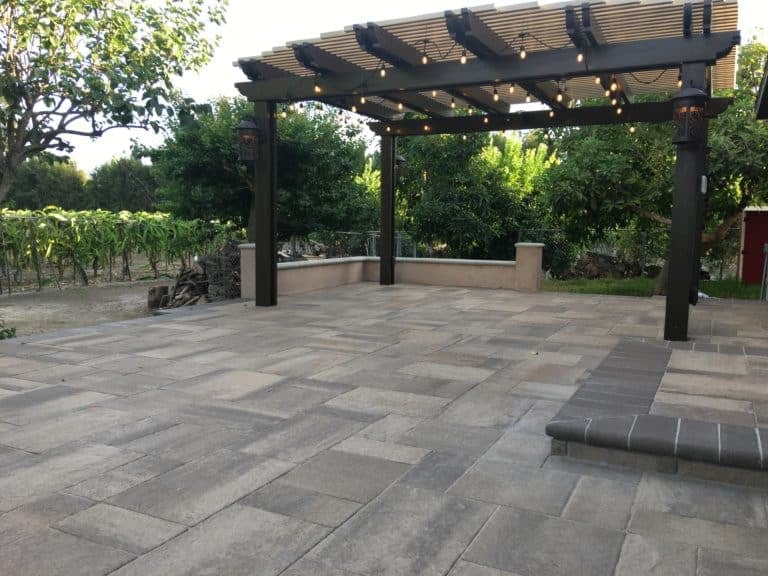
The pattern carries load too. We lay driveways in herringbone because a rolling tire never finds a straight seam to push along, while a running bond that looks tidy on a walk creeps under wheels. The pavers are the thicker driveway grade rather than thin patio units, and the border is set in full-size pieces, because small cut slivers at the edge are the first to rock loose.
If plain poured concrete fits the budget better, our concrete driveway crew does that work; the side-by-side is in pavers vs concrete for a driveway. Paver driveways are part of our paver installation work, and one estimate can price either route.
 Interlocking pavers, edge to edge
Where the water goes, and what happens when something needs fixing
Every driveway is pitched toward the street or to a channel drain across the garage threshold, never toward the house, and the joints let some rain through instead of sending all of it down the gutter. On a lot with nowhere to send runoff, permeable pavers with wider stone-filled joints let the whole driveway drain into its base, tied into drainage and grading when the yard needs more.
The reason people choose pavers for a driveway shows up years later. A sewer line needs replacing, or a trailer jack punches a dent. We lift the affected pavers, fix the base, and set the same pavers back with fresh joint sand: no saw cut, no patch that never matches.
Tire marks are normal in the first months and fade with rain and sun; mixed-tone blends hide them best. Sealing is a choice, not a requirement: it deepens the color and makes marks easier to rinse, and it needs redoing over time. Weeds arrive as seeds landing in the joints, not from below, so polymeric sand that hardens in the joint is the defense, topped up when it wears. The matching paver walkway to the door is set from the same pallet, on a lighter base.
What local ground does to a paver driveway, and what decides the price
Ventura County has no freeze-thaw, so joints are never pried open by ice. What the driveway has to survive is the soil and the trees. A street tree root under the apron is cut back or bridged at install, and we tell you that section may need a reset one day.
Inland clay swells and shrinks with the seasons, so the base goes deeper with fabric under it; sandy soil near the coast drains but needs compacting before rock goes down. Price follows square footage, dig depth, whether an old slab has to come out, the paver you choose, the cut count at the borders, and access for the excavator.
On the day, the old driveway comes out through demolition and site prep, the excavation is checked for depth and soft spots, and the base goes in lift by lift under the plate compactor. Pavers are laid from the garage toward the street, cut at the borders, compacted into the sand, and joint-sanded. You park on the street until the crew says the sand has set.
Upkeep after that is a rinse, the odd weed pulled from a joint, and sand swept in where it has worn. VC Turf is a California licensed contractor, CSLB #1036018, and every driveway is measured and priced in person. Finished driveways are in the gallery.
What people ask about paver driveways
Yes, when the base is built for it from the start. Tell us at the estimate where the heavy vehicle will sit, because that strip gets the deeper excavation and fabric, and the whole driveway goes in with the thicker paver so the two areas match.
Not when the pattern is herringbone and the restraint is spiked along the apron and both sides. Shifting on an older driveway usually traces back to a running bond lay, an edge with nothing holding it, or base rock dumped in one layer.
We lift the raised section, trim or bridge the root, rebuild that patch of base, and reset the same pavers with fresh joint sand. The repair blends because the pavers are the originals. It is the most common paver driveway repair on streets with mature parkway trees.
A larger job, or one that changes the apron or curb cut at the street, may need a permit or engineering, and we tell you at the estimate what applies to your driveway before any work is scheduled.
Yes. The units are driveway grade. What changes is underneath: the base is open, clean stone so water passes through, and the joints are filled with small stone instead of polymeric sand. They cost more in base material and suit a lot where runoff has nowhere else to go.
Get a free estimate for your paver driveway
Tell us what parks on it and whether the old driveway is still in place. We will measure, check the soil, and bring paver samples to hold against the house. Send the form or call and we will set a time.