Pavers vs concrete driveway: the cheaper bid is not always the cheaper driveway
Ask three neighbors about pavers vs concrete for a driveway and you will hear the same shorthand: concrete is the cheap one, pavers are the pretty one. The Concrete Masonry and Hardscapes Association, the trade body that took over the Interlocking Concrete Pavement Institute, opened a December 2025 article on the subject with the one thing every slab owner learns eventually: there are two types of concrete, concrete that is cracked and concrete that will crack. That is the whole argument in one line, and it is also only half of it.
The myth: the lower bid is the lower cost
A driveway bid is a day-one number. What a driveway costs is that number plus every repair, every trench a plumber has to cut through it, and every time the ground underneath decides to move. Concrete usually wins the first column. Whether it wins the whole row depends on the lot, and no price list can answer that for you.
Start with what each surface is. A paver driveway is hundreds of separate concrete units set on sand over a compacted rock base, locked together by the pattern and held at the edges by restraint. The association’s article calls that a semi-flexible system and notes that the units are manufactured with two to three times the strength of typical poured concrete. A concrete driveway is one rigid slab, poured over a compacted base with steel inside it and joints cut across it. Both are concrete. They just fail, and get fixed, in opposite ways.
When poured concrete cracks, it loses its ability to transfer loads across the damaged area. Pavers maintain their structural functionality even when there’s movement or settling.
The fair reply on concrete’s behalf is that a crack is not a failure if it lands where the crew planned it. Control joints exist so the shrinking slab cracks inside a groove, in a straight line, where nobody notices. A slab that cracks at its joints has done exactly what it was designed to do. The myth is not that concrete cracks. The myth is that the crack is free.
What the ground does to each driveway
Every driveway sits on dirt, and some dirt does not hold still. The Colorado Geological Survey describes expansive soils as ground laced with clays that absorb large quantities of water, and it puts the numbers plainly: such soil can expand up to 20 percent by volume when it gets wet, and it can push with a force of up to 30,000 pounds per square foot. The survey lists cracked driveways and sidewalks among the losses, and it ranks expansive soil ahead of tornadoes, floods, earthquakes, and hurricanes for the property damage it causes nationwide each year.
Put a rigid slab on soil like that and the slab loses the argument every wet winter. Put pavers on it and the surface moves too, but as a group of small units that can be opened and reset once the ground settles down. That is the physics behind the association’s line about pavers keeping their structural function through movement, and it is the strongest case pavers have.
It is not a case against concrete on every lot. Well-drained ground that never swells gives a slab nothing to fight, and a slab poured there on a compacted base with sensible joint spacing can stay flat for a very long time. The question is never which surface is better in the abstract. It is which one suits the dirt you own.
VC Turf installs both surfaces across Ventura County, and the estimate for either one starts by looking at the soil rather than the catalog. Where the ground is the kind that swells, the base goes deeper under either surface, and the crew says so before a pattern or a finish is chosen.
Pavers and concrete, one criterion at a time
Pick a group of criteria to see that section of the table. The last column shows which surface has the edge on that point; your lot decides how much it matters.
| Criterion | Paver driveway | Concrete driveway | Edge |
|---|---|---|---|
| Look and options | |||
| Surface | Many units in a pattern, with mixed color blends and an optional border. | One continuous surface, broom finished, with color or a washed band as an upgrade. | Taste, not physics |
| Curves | Cut unit by unit at the edge; a bend costs labor. | Forms bend easily; a curve is simple to pour. | Concrete, slightly |
| How it ages | Color runs through the unit; tire marks fade. | Surface can dust or stain; a sealer slows it. | Pavers, slightly |
| How it handles ground movement | |||
| Soil swells or settles | Units move as a group and stay usable. | The rigid slab cracks; the joint layout decides where. | Pavers |
| Tree roots | Open the lifted section, deal with the root, reset. | Cut out the heaved panel and repour it. | Pavers |
| Weak native soil | Needs fabric and a deeper base or it ruts. | Needs the same compacted base or it cracks and rocks. | Neither forgives a bad base |
| Repairs | |||
| A sunken spot | Lift, add base, level, reset, compact. No visible patch. | Cut out and repour a panel; the new pour never matches. | Pavers |
| A utility trench | Pavers come up and go back down. | Saw-cut the slab and repour a strip. | Pavers |
| Parking again | Once the reset is compacted and sanded. | After the repoured section cures. | Pavers |
| Upkeep | |||
| Joints | Joint sand tops up as it wears; weeds land in joints. | Control joints stay clear; nothing to top up. | Concrete |
| Cleaning | Rinse; sealing is optional. | Rinse; sealing is optional. | Even |
| Edges | Edge restraint must stay anchored. | Edges chip if a tire drops off; otherwise fixed. | Concrete, slightly |
| Cost over time | |||
| Day-one bid | Usually the higher number: more material, more hand labor. | Usually the lower number: one crew, one pour. | Concrete |
| First real repair | Lift and reset the original units. | Cut, dispose, repour, cure; the patch shows. | Pavers |
| What drives the gap | Pattern, border, paver grade, base depth for the load. | Slab thickness and mix strength, finish, how much old slab comes out. | Depends on the lot |
| Resale | |||
| Curb appeal | Reads as a designed surface. | Reads as tidy when new, less so once patched. | Pavers |
| The buyer’s question | Will the pavers shift? A good base answers it. | Why is it cracked? A good joint layout answers it. | Even |
Where the two driveways stop being twins
For the first few years the two surfaces behave like twins. Both drain to the street, both carry the cars, both get hosed off. The split shows up the first time something underneath needs attention. The association describes the paver fix in one breath: lift the pavers, fill the aggregate base, level it, put the pavers back, compact. The same article describes the concrete fix as cutting out and disposing of the damaged section, pouring new material, and waiting days for it to cure. One repair uses the driveway you already own. The other buys you a patch in a slightly different shade of gray.
That is the part of the ledger the day-one bid never shows. It matters most on lots with parkway trees, old sewer lines, or clay, because those driveways will be opened at least once. It matters least on a flat, well-drained lot with new utilities, where a slab may never need anything.
Upkeep runs the other way. The association’s own article says it plainly: everything we build needs some level of maintenance. A paver driveway asks for joint sand topped up as it wears and the odd weed pulled from a joint, and its edge restraint has to stay anchored. A slab asks for a sealer now and then and otherwise leaves you alone. If you would rather never think about the driveway again, that is a real point for concrete, and it belongs in the comparison.
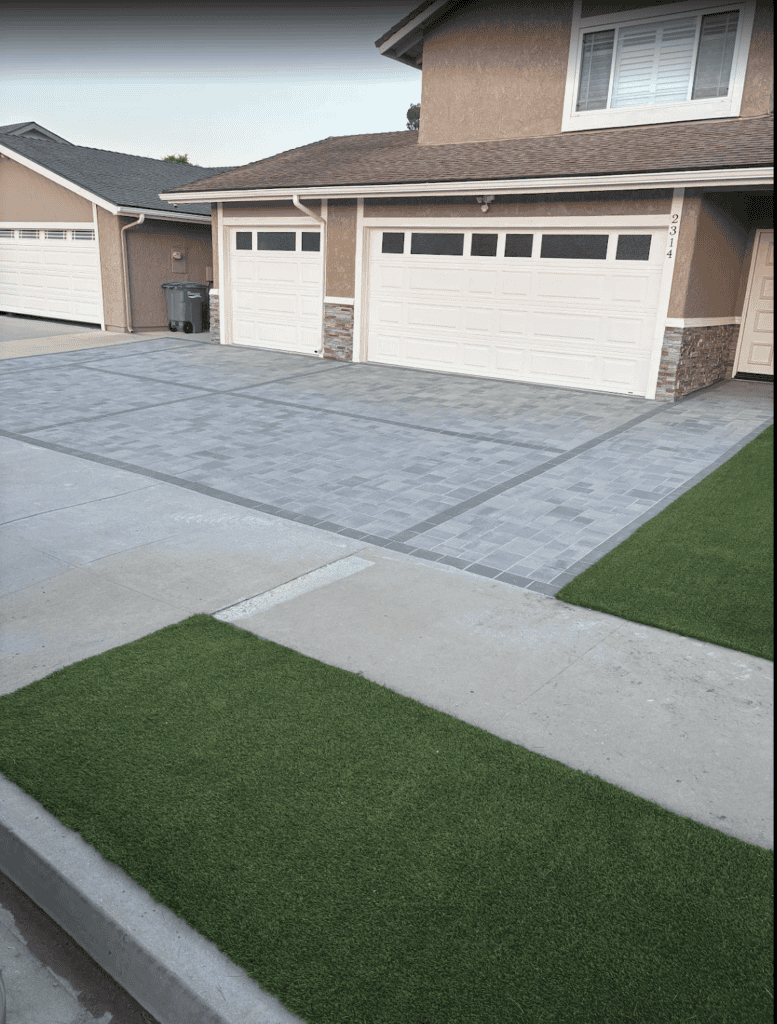 VC Turf project
How to read two bids without a price list
You will get two numbers, and the paver number will probably be the larger one. Before you react to the gap, read what each bid includes, because the cheaper driveway is often the one that left something out. Four things are worth finding in writing on either bid.
What is under the surface
Base depth, fabric over weak soil, and whether the rock is compacted in layers. A bid that skips these is cheaper on paper for either surface and costlier by year five.
What holds it together
Pavers: pattern, paver grade, and edge restraint on every open side. Concrete: slab thickness and mix strength, steel, and a joint layout drawn before the truck arrives.
The repair path
Ask what the fix looks like when a root lifts a corner or a plumber has to dig. Pavers: lift and reset. A slab: cut and repour a panel, with an honest note that the patch will show.
Resale, honestly
No verified local resale figure exists for either surface, so none appears here. A buyer sees a designed surface versus a plain one, and intact versus patched. Weigh that against the day-one gap.
If the finish matters more to you than the pattern, a slab with a colored or washed band can close some of the visual gap, and the wider paver installation catalog is worth a look if you want the driveway, walk, and patio to read as one surface. Either way, the soil on your lot settles the choice before the catalog does.
Frequently asked questions
In most bids the paver driveway carries the higher day-one number, because there is more material and more hand labor at the borders. The gap is set by the pattern, the border, the paver grade, and how deep the base has to go for what parks on it, so two driveways of the same size can land far apart. The honest comparison adds the cost of the first real repair to each number before you decide.
The base under either one decides that, not the surface. A slab on a compacted base with a planned joint layout and a paver driveway on a deeper base with edge restraint are both long-term surfaces. The difference is what happens when the ground moves: the pavers are reset, while the slab gets a patch or a repour.
No, but it has to be built for it. The Colorado Geological Survey describes clay soils that can expand up to 20 percent by volume when they take on water, and cracked driveways sit high on its list of the damage they cause. On ground like that a slab needs a deeper compacted base and tighter joint spacing, and it is worth asking whether a surface that can be lifted and reset fits the lot better.
The shorthand your neighbors gave you is not wrong, it is just incomplete. Concrete is usually the lower bid and pavers are usually the better-looking surface, and on the right lot either one is a good driveway. VC Turf builds both, so the estimate is a chance to have the soil looked at by a crew that does not need you to pick a side first.
Call any hour of any day, or send a note through the contact page. We measure the driveway, check the ground, and price the surface that fits it. California licensed contractor, CSLB #1036018.