Concrete driveway contractor for Ventura County homes: new driveways poured to last
VC Turf is a concrete driveway contractor for Ventura County homeowners who are done patching a driveway that keeps breaking up. We take out the old slab, fix what failed underneath, and pour a new one on a compacted base with the fall, the reinforcement, and the joint layout a slab carrying cars needs.
Six signs a concrete driveway is past patching
A driveway rarely fails all at once. A hairline crack is normal, but a crack that has opened up, or one with the far side sitting lower than the near side, means the ground under it moved. Heaving at the garage apron, crumbling edges, rain that runs toward the garage door, and patches laid over patches are the other signals.
Mark every symptom you can see from the sidewalk.
Turn on the symptoms that match your driveway to see whether it reads as a repair, a replacement, or a closer look.
A rough read from the sidewalk. The estimate confirms it: we walk the slab, check the fall, and look under the failed sections.
An honest line between fixing a driveway and replacing it
We pour new driveways as part of our concrete contractor work, so it would be easy to tell every caller to start over. A slab with a sound base and a cosmetic problem should be repaired, and we will say so. The trouble starts when the ground under the driveway has failed, because a patch on moving soil moves with it.
Repair makes sense when
The base is sound, the panels sit level, and the damage is surface flaking or a crack that has not moved.
Replacement makes sense when
Panels have lifted or sunk, cracks have opened, water runs to the garage, or patches have failed twice.
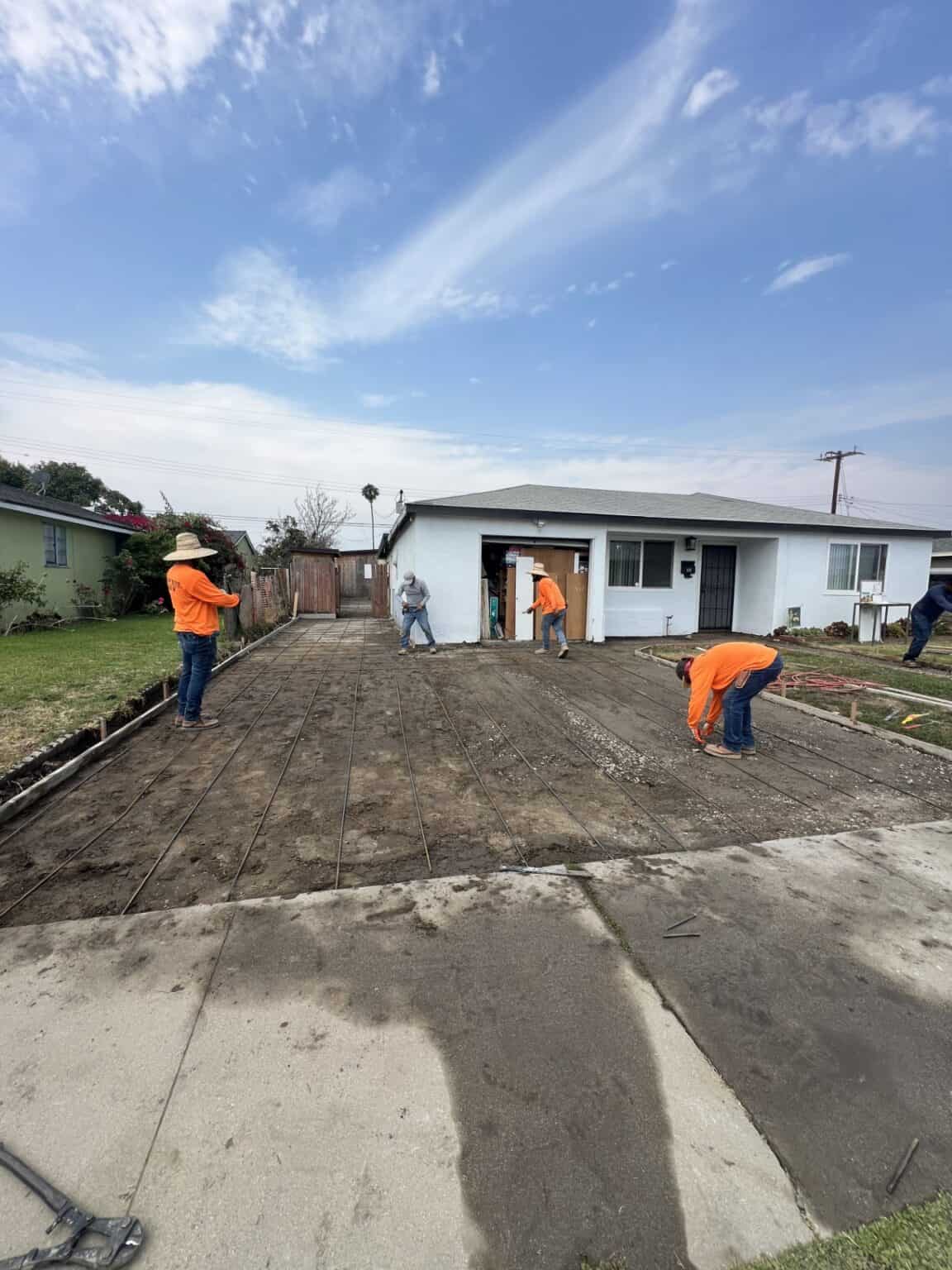 Before
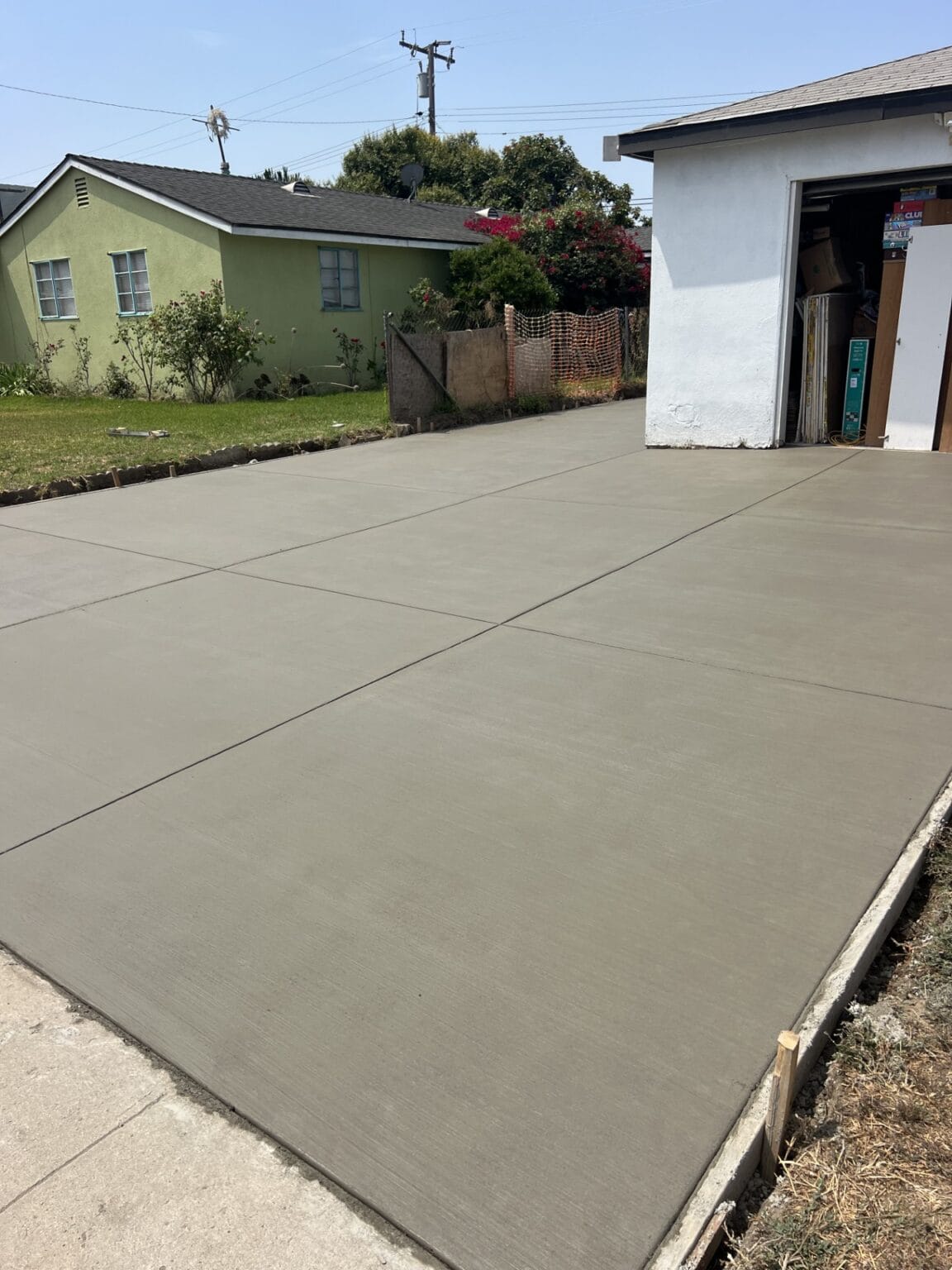 After
AfterA replacement driveway: old slab out, new base, new pour, joints laid out in panels.
The order the crew works in, from the first saw cut to the cure
Skip a step and it shows up later as a crack, a puddle, or a slab that rocks.
Demo and haul-off
The old slab is cut, broken up, and hauled away with whatever was patched on top. Roots that heaved it come out now.
Subgrade compaction
The exposed soil is graded to the new fall and compacted. Soft pockets are dug out and replaced so the base has nothing soft under it.
Base rock
Crushed rock goes down in lifts, compacted between them, then leveled so the slab is the same thickness everywhere.
Forms set to fall
Form boards are staked around the outline with the tops set to drain away from the garage. Flares and borders are formed here too.
Reinforcement
Steel is tied in a grid and propped up so it sits inside the pour. It holds a crack closed; it does not stop one from forming.
Pour, screed, float
The mix is placed, pulled level to the form tops, then floated. On hot days this happens early and in stages.
Finish and joints
A broom is dragged across for grip. Control joints are tooled or saw-cut in a layout planned before the truck arrived, so the panels line up with the apron.
Cure, then seal later
The slab is kept damp or covered while it hardens, and nothing parks on it until it has cured.
Choices made at the forms
Width is set by the cars you park, not the old outline. Room for two vehicles door to door, a turnout for a third, or extra width along one side so nobody steps out onto dirt all get formed with the main slab, along with a flared apron at the street and any border. These are easy to add on the day and disruptive to add later.
Finish options past plain broom
Broom is the default because it grips. If you want color mixed in, a washed surface that shows the stone, or a band of either as a border, our decorative concrete service covers those finishes. If you want a pattern rather than a finish, compare this page with a paver driveway, which we also install.
What the ground here does to a driveway
Clay under a driveway lifts the apron first, because the garage side stays dry while the street side soaks. We deepen the base at the apron and space joints tighter there. Sandy lots near the coast need the subgrade compacted twice before rock, or tire tracks settle into ruts.
Parkway trees send roots straight under the apron. If a root heaved the old slab, cutting it back is part of demolition and site prep, and where it will grow back we talk about shifting the edge of the pour. Summer heat makes concrete set fast, so a hot-weather driveway is poured at first light and finished in sections. What we do not fight is frost. Without freeze and thaw, a slab on a sound base has nothing prying it apart from below.
What to expect on the day, and how to keep the driveway sound
The truck arrives early, the crew pours in one visit, and you park on the street until we say the slab is ready. After that, hose it off, sweep leaves, and reseal when water stops beading. Price follows size, how much old slab comes out, the base depth the soil needs, and the finish. VC Turf is a California licensed contractor, CSLB #1036018.
The saw comes out after the pour for the joints, and you walk on the slab before you park on it; the heaviest vehicle waits longest, and the dates depend on that week's weather. Keep water off the edges: a downspout or sprinkler soaking the ground beside the slab washes out the base, and drainage and grading fixes that at the source. Keep the joints clear of weeds. The slab will still crack somewhere as it shrinks; the joints make that somewhere a straight line you never notice.
What homeowners ask about a new concrete driveway
Those are control joints. Each one is a weak line the shrinking slab is meant to crack along, hidden inside the groove, spaced into even panels and lined up with the apron. A slab poured without them picks its own line, usually a diagonal from a corner.
Yes, and a replacement is the time to do it, since the new width gets the same base and pour as the rest instead of being stuck on as a strip. The one piece we cannot decide alone is the apron where it crosses the sidewalk and curb, which sits in the public right-of-way. If a wider approach needs the city's sign-off, we tell you at the estimate.
It will hold up without one, but a sealer is worth the small extra step. It closes the pores so oil drips, rust from a parked trailer, and leaf stains wipe off, and near the beach it slows salt air working into the top. The first coat waits until the cure is complete; sealer applied too early traps moisture and turns cloudy.
Larger jobs may need a permit or engineering, and we tell you at the estimate, before any pour date is set.
We install both, so the answer depends on you. Concrete is one continuous surface with the simpler bid and no sand joints to sweep. Pavers give you a pattern and let one stained or sunken piece be lifted and reset. Our pavers vs concrete driveway post lays the two side by side, and the estimate for either is free.
Get a free estimate on a new concrete driveway
Send the form or call during business hours and we will set a time to walk the driveway with you. We measure it, check the fall and the soil, look at what is under the failed sections, and price the replacement with the width and finish you want.