
Artificial turf cost per square foot in California: what a real bid contains
Artificial turf cost per square foot in California is the number most homeowners want before they call anyone, and the honest answer is a range with five things inside it. This guide opens the range up so you can read a turf bid line by line.
Outdoor use accounts for nearly half of all urban water use in California, according to the Public Policy Institute of California’s 2023 water-use brief. That is the budget line a lawn sits on, and it is why a turf quote gets read differently here than in a wet state, and why the per-square-foot number gets asked first.
What the per-square-foot number includes
The range on VC Turf’s products page, as published in September 2026, runs from $7 to $12 per square foot installed, materials and all other costs included. It is the only price in this guide, and it is a published range, not a quote for your yard. A dead lawn on flat sandy soil sits near one end; a yard with a slab to break up, a narrow gate, and clay that needs drains sits near the other. The square-foot figure compares bids on the same yard and falls apart across two different yards.
Two things get left off most price lists. The first is what has to come out; a lawn, a slab, and bare dirt haul very differently, and that work is described on our demolition and site prep page. The second is the base. Turf over a thin or loose base ripples within a year, and the rock and compaction under it belong in the square-foot price on an honest bid. The layers are drawn out on our artificial turf installation page.
Turf grade: face weight from 73 to 126 ounces
Face weight is the amount of yarn in a square yard of turf, and VC Turf’s range runs 73 oz to 126 oz. On a bid it is the biggest lever on the material line: more yarn per yard means more blade to hide the backing and more resistance to matting where people walk every day, at a higher price per roll. VC Turf’s own breakdown assumes medium to high grade turf when estimating a project, because a low-end roll saves a few dollars and then looks thin from the sidewalk within a few seasons.
| Grade | Face weight | Where it belongs | Effect on the bid |
|---|---|---|---|
| Lighter | Toward 73 oz | Side strips nobody sees, areas with no foot traffic | Lowest material line, shortest useful life |
| Middle | Middle of the range | Front lawns, backyards, most dog yards | Where most bids land |
| Heavier | Toward 126 oz | Display yards, daily paths, party lawns | Highest material line, longest wear |
Grade moves the material bucket and barely touches the other four.
The five buckets in a real turf bid
VC Turf’s own breakdown sorts a bid into five categories, and a bid that cannot be sorted into them leaves you guessing. Pick a bucket to see what sits in it and what moves it. No figures on purpose: the published range above is the only one that fits every yard.
Materials
Turf is the headline item, and its face weight sets most of this bucket. The rest is what goes under and around it: weed barrier, base rock or decomposed granite, gopher mesh, infill, nails and seam tape, and the border, whether pavers, rock, or mulch.
Moved most by turf gradeHeavier turf, a deeper base on clay or slope, paver borders, cuts around trees and beds.
A simple rectangle, lighter turf where nobody walks.
What moves your number up or down
Square footage is bought by area, so the total scales with the lawn, but the per-square-foot rate moves with everything else. What has to come out is the first swing: sod on dirt is one bin, a slab is several plus a breaker. Access is the second; a gate too narrow for a skid steer means wheelbarrows and more crew hours for the same rock. Soil is the third. Clay wants drains and a deeper base; sand will not hold a grade until it is compacted harder. Slope adds cuts. Then the turf grade, which sets the material line more than any other choice you make.
None of that shows up in a number quoted over the phone. It shows up when someone stands in the yard, checks the soil, looks for gopher mounds, and measures the gate. The other side of the ledger, what a lawn costs to keep, is on our lawn removal and turf conversion page.
Roughly three quarters of Ventura County residents use water their retail purveyor buys from Calleguas Municipal Water District, whose primary role is importing Metropolitan Water District supply, mainly State Water Project water, according to the district’s overview page. A lawn here lives on imported water, and every restriction lands on it first. That is the line a turf bid is measured against.
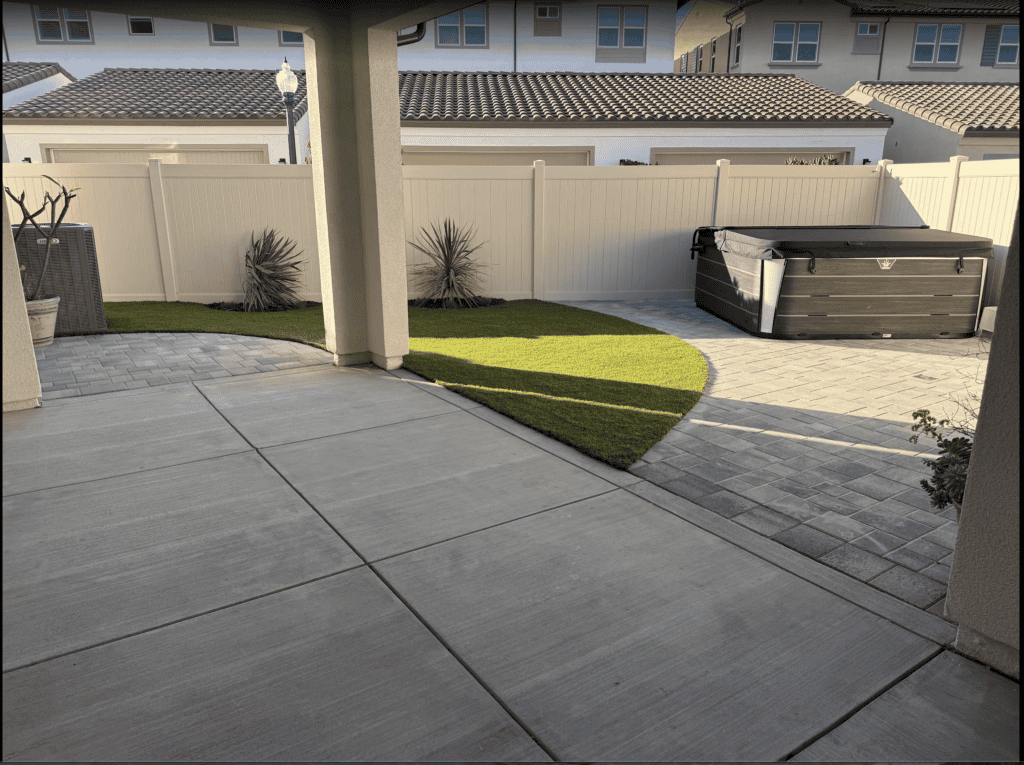 Turf and paver edge
How to read two turf bids side by side
Put them on the same square footage first; if one crew measured 900 square feet and the other 1,100, the per-foot rate means nothing until that is settled. Then ask each for the five buckets. A bid that names the turf and its face weight, the base depth, the mesh, and the haul-off can be compared. A bid that says turf, installed, one number, cannot. Ask what happens to the sprinklers and how the base gets compacted. Ask how many turf yards the crew has finished; experience shows in the seams and the base.
Then look behind the low number. A bid can be low because the turf is lighter, the base thinner, the crew uninsured, or nothing set aside to come back. It can also be low because the yard is easy. Only the line items tell you which.
SoCal Water$mart’s turf replacement rebate, as listed in September 2026, excludes synthetic turf, so it helps with the planted part of a yard and not the turf; check the program page before you apply.
Labor is the most important line. You get what you pay for there, and the long-term durability of the project rides on it.
Frequently asked questions
No. It is the range VC Turf publishes for an installed project, materials and all other costs included, as of September 2026. Your number comes from a written estimate after someone has measured the yard, checked the soil and access, and priced what has to come out.
The material line goes up with face weight, so yes on that bucket. The rest of the bid barely moves, because the base, haul-off, and labor are about the same under a 73 oz roll and a 126 oz roll. Where people walk every day, the heavier turf is the cheaper one over its life.
Because labor is where a turf job is won or lost, and crews price it by how much of it they plan to do. Compacting base in lifts, laying mesh, cutting clean seams, and nailing edges take crew hours. A crew that skips them can bid less, and the yard shows it within a season.
A square-foot number is a place to start, and a written estimate with five buckets in it is where a decision gets made. For a yard in Ventura County, we will measure it, bring the turf samples, and put every line on paper.
Get the bid with the buckets in it
Free estimates. Materials, haul-off, and labor spelled out, turf grade named.