
Artificial turf, pavers, and concrete in Fillmore
VC Turf installs artificial turf, pavers, and concrete in Fillmore, from the older blocks off Central Avenue to the newer homes at The Bridges and along Heritage Valley Parkway. We are based in Ventura, roughly 25 miles down the 126. The question we hear most here is whether to put turf, decomposed granite, or rock where the lawn was, on valley ground that stays wet for days after a winter storm and bakes through July.
Turf, decomposed granite, or rock: what goes where the Fillmore lawn was
Fillmore sits on the valley floor between the Santa Clara River and the foothills, on the same alluvium the orchards use. The ground under the lawn is river silt and clay with pockets of sand and gravel, soft a week after rain and hard as a road in August. Pick a ground cover to see how it does on water, upkeep, heat, and standing water. The estimate at the house settles which zone gets which.
Artificial turf on a Fillmore lot
Best where the family, the dog, or the front of the house needs green all year| Water | None to keep it alive. A rinse now and then clears orchard dust and anything the dog leaves, and the sprinkler zone gets capped when the lawn comes out. |
|---|---|
| Upkeep | Brush the pile up a couple of times a year, keep leaves off it, and pull the odd weed at the edge. Gopher mesh under the base matters on lots that back onto groves, because the gophers do not stop at the fence. |
| Heat underfoot | Warmer than grass in full sun, and Fillmore afternoons in July and August get well into the nineties and past a hundred on the bad days. Lighter blade colors and some shade help, and a quick hose-down cools it in minutes. |
| Standing water after rain | The backing drains, but only as fast as what is under it. Laid straight on Fillmore silt, turf sits on a puddle. We build it on compacted class 2 base with a fall to a drain or the street, so the water goes through and leaves instead of sitting under the backing. |
Decomposed granite on a Fillmore lot
Best for side yards, paths, and the big lot you do not want to mow or water| Water | None. A DG field takes the whole zone off the city water bill, which is why people in the older grid ask about it for the strip they never used anyway. |
|---|---|
| Upkeep | Weeds come up through it unless there is weed barrier underneath, a heavy storm can rut it, and it wants a rake and a fresh compaction every so often. |
| Heat underfoot | Cooler than turf and cooler than dark rock, and its tan color stays easy on the eyes in the summer glare. The trade is dust in the dry months when it is walked on a lot. |
| Standing water after rain | On a flat Fillmore lot with no fall, it holds water like the soil under it and turns to paste in a low spot. Crowned, edged, and compacted over a base that drains, it does fine. |
Decorative rock on a Fillmore lot
Best along the drip line, the side yard, and the beds between turf and the fence| Water | None for the rock. If there are plants in it, a drip line runs under the rock and weed barrier, and that is the only water the bed uses. |
|---|---|
| Upkeep | Leaves and blown-in dirt settle between the stones and want a blower now and then, and rock migrates onto walks unless there is an edge. It does not need re-compacting and it does not rut. |
| Heat underfoot | Depends on the color. Dark rock next to a south wall gets too hot to touch on a Fillmore afternoon and radiates into the house at night; light rock stays cooler and throws glare. |
| Standing water after rain | Water goes straight through rock, which is why it is our first pick along a drip line or a downspout. The catch is the ground under it: the water still has to leave, so we grade the bed to a drain or the street before the barrier and the rock go down. |
Artificial turf in Fillmore that sits on rock, not on wet silt
Fillmore runs its own city water utility, so the lawn is on a city bill with no big district behind it, and that is usually what starts the conversation about artificial turf. The build here is about what is under the turf. The sod and the top few inches of soil come out, the sprinkler heads in that zone get capped below grade, and we set the grade so the whole pad falls toward the street or a drain. Then class 2 base goes in and gets compacted until it stops taking a footprint. On this ground that step is not optional; base laid thin on Fillmore silt pumps up and down with the winter and the seams show it by spring.
We install turf from established manufacturers, products backed by manufacturer warranties, and we expect a properly based install to give you 15 to 20 years. Because the summers get hot, we bring samples in a few blade colors and pile heights to the estimate so you can pick the one that feels right, and on any lot that backs onto a grove we put gopher mesh under the base before the turf goes down.
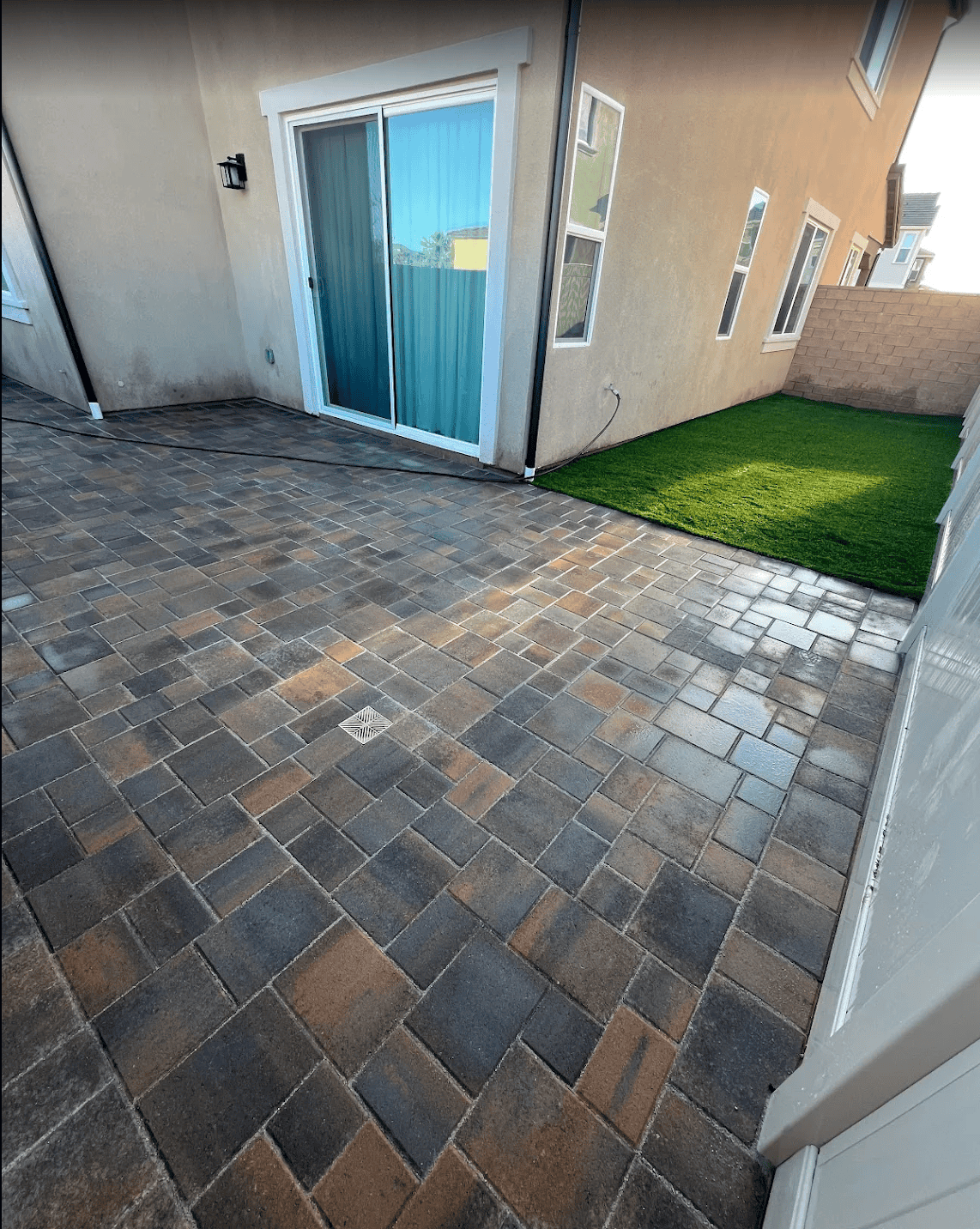 Turf where the family sits, hardscape where they walk
Paver patios and driveways with a deeper base for Fillmore ground
Fillmore patios and driveways get a deeper base than most of the county, and this is why. Pavers are only as flat as what they sit on, and soil that swells wet and shrinks dry moves whatever is on top of it. So on a Fillmore driveway or patio the excavation goes deeper than it would on the sandy lots in Ventura, the base goes in and gets compacted in lifts rather than in one pass, and the edge gets a solid restraint so the field cannot spread when the ground softens in February.
In the newer neighborhoods, The Bridges off River Street and the homes around Heritage Valley Parkway, the yards are small and the ground is graded fill from the build, so we compact our own base rather than trust the builder's. Where a community has an association, we give you the layout and the paver color for the submittal. On the older grid off Central Avenue and A Street the lots are bigger and the plan is usually a patio, a walk to the side gate, and turf or DG for the rest.
What a Fillmore paver base gets
Concrete driveways and slabs that send the water somewhere on purpose
A concrete driveway or patio in Fillmore fails the same way most of the old ones did: poured flat on soil that holds water, it ponds at the low corner, the corner stays soft, and the slab cracks along the line where the ground moved. So every slab we pour here gets a compacted base of its own, forms set with a fall toward the street or a drain, steel tied so the slab moves as one piece, and control joints where the cracks would have gone anyway.
When the ground itself is the problem, a yard that is soft for a week after every storm, the slab is the last thing we do. A regrade, a drain line to the curb, or a channel drain at the patio edge comes first, and that drainage and grading work is its own line on the estimate so you can see it.
Where you'll find us working
We come up the 126 from Ventura and it turns into Ventura Street through town, with Central Avenue running north from it into the older grid and the 23 heading south over the river toward Moorpark. The work spreads from those blocks around Central and A Street out to The Bridges on the River Street side and the Heritage Grove and Heritage Valley Parkway homes on the east end. Santa Paula is the next town down the valley and Piru is the next one up, and every town we cover is on the service areas page.
Two kinds of Fillmore yard
The older grid north of Ventura Street: bigger lots, older soil that has never been disturbed below the lawn, and usually no board to answer to. The newer tracts on the west and east ends: small yards and an association in some of them and none in others.
Why Fillmore chooses VC Turf
A licensed crew from down the valley that will tell you when DG is the better answer than turf, and builds the base either way.
Carlos was very thorough in his explanation of materials, accurate in his estimation of start and completion times. Extremely satisfied with the customer service and quality of the work.
His team or crew was very respectful and cleaned up after install. Definitely recommend his services and vision for your projects at home.
Carlos and his crew were phenomenal. Detail oriented, responsive, hard working and delivered exactly what was expected. They are professionals through and through, I highly recommend VC Turf to anyone looking to transform their outdoor space.
Before the Fillmore lawn comes out
Not one we could point you to. The city is its own water utility, and its site talks about conserving water but we did not find a lawn-to-turf or turf-removal payment listed. Call the city's utility desk and ask what is current before the sod comes out, and plan the budget as if the answer is no. If a program does turn up, it will have its own rules about what can replace the grass.
You can, and on a lot that has a little fall to the street it works well. On a dead-flat lot it is the material most likely to disappoint, because it holds water the way the soil does and goes soft where it ponds. The usual fix is a strip of turf or a paver walk where people actually step, DG in the field with a crown and an edge, and the whole thing graded so the low spot is at the curb, not the porch. We lay it out that way in the drawing so you can see it before it is built.
Three things. Gopher mesh goes under any turf, because the groves are full of them. The back fence line gets looked at for water coming in from the grove side after irrigation or a storm, and if it does, a drain or a low curb along that edge goes in first. And the turf or rock along that fence gets a rinse now and then, since dust off the rows settles on it.
Fillmore's building counter sets the thresholds, and they change, so we ask before we price rather than guessing. Turf and a patio or walk at grade rarely need one. A taller retaining wall, a wall that holds back a slope, or a new driveway approach at the curb often does. At the estimate we tell you which of those your plan touches and what the counter said.
Fillmore is about 25 miles up the 126 from our shop, so we plan around the drive. Base rock and turf land on the lot the morning we start, the crew stays on the job through to the finish, and if a wall or a curb cut needs a city visit, that happens before day one.
Bring the question about turf, DG, or rock to the estimate
Call during business hours or send the estimate request with your street and a note about where the yard stays wet in winter. We come up the 126, walk the lot with you, and price each zone as turf, ground cover, pavers, or concrete, in person and at no cost.