
Artificial turf, pavers, and concrete in Newbury Park, from the flats to the hillside lots
VC Turf installs artificial turf, pavers, and concrete in Newbury Park, from the established streets around Borchard Road to the Dos Vientos tracts that back onto the Santa Monica Mountains. We are based in Ventura, a little over 20 miles down the 101 and up the Conejo Grade, so an estimate here is an easy morning drive. On most lots in this town the yard has a slope in it somewhere, and that decides the order of the work before any product does.
Off the four Newbury Park exits, both sides of the freeway
VC Turf does three kinds of work in Newbury Park: artificial turf where the lawn was, pavers for the driveway and patio, and concrete for the walks, porch, and side-yard pads, with the planter walls and drains a hillside lot needs before any of it goes in. The crew comes out of Ventura, and the run covers everything from the Borchard Road tracts to the Dos Vientos pads under the mountains.
We come in off Ventu Park Road, Rancho Conejo Boulevard, Borchard Road, and Wendy Drive. South of the 101 that puts us on the older streets between Borchard and Reino Road, near the Newbury Park Shopping Center and the library, then west along Borchard into Dos Vientos, where the newer tracts climb toward the open space. North of the freeway it is the gated pockets of Rancho Conejo off Ventu Park Road, up against the Simi Hills, and the older custom lots of Ventu Park.
Newbury Park is the west end of the City of Thousand Oaks, which matters for whose rules apply to your yard, and we cover that below. Thousand Oaks proper and Camarillo at the bottom of the grade have their own pages, and every town we cover is on the service areas page.
Turf for a town that runs cooler than the rest of the valley
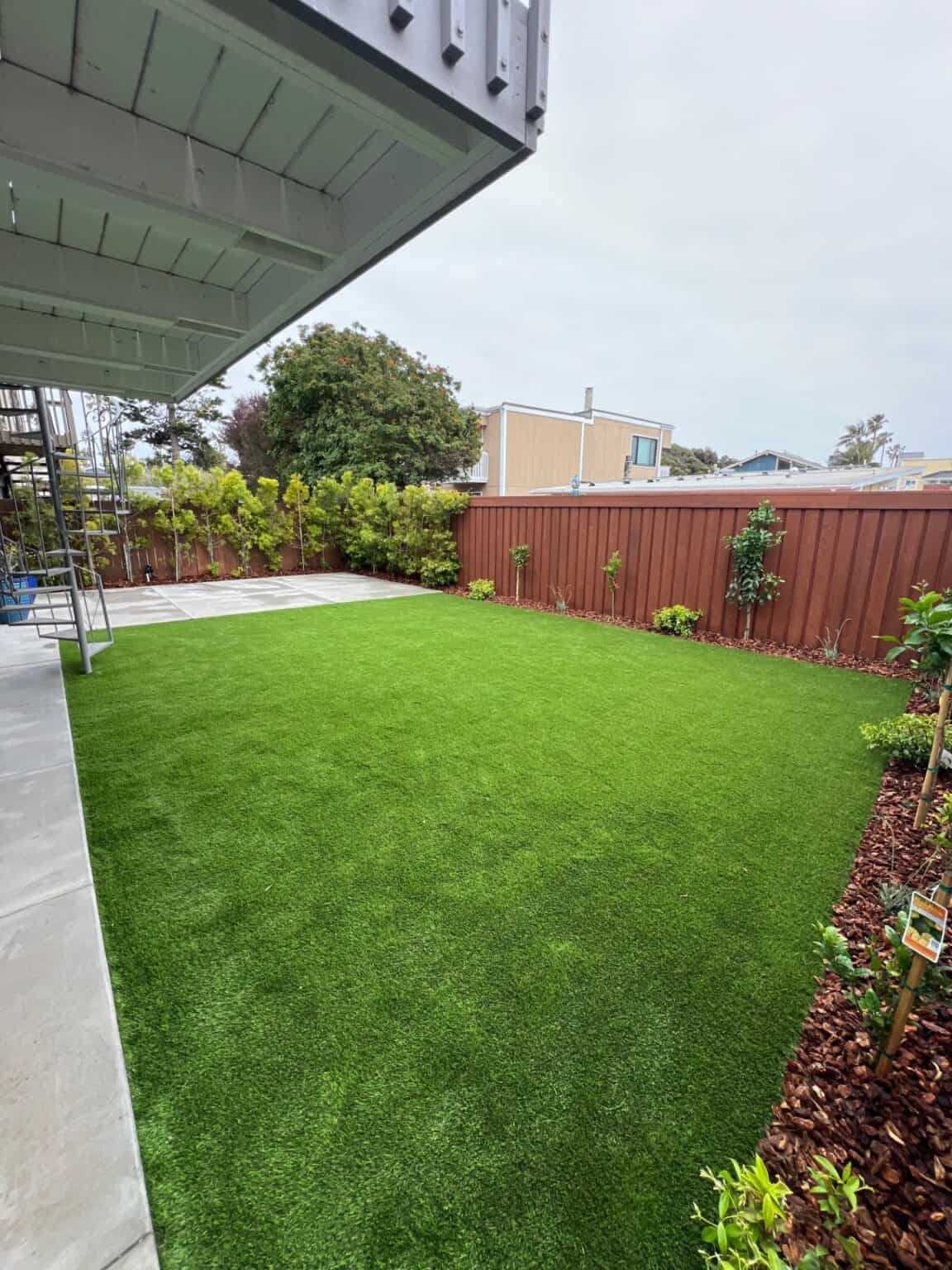
Newbury Park is usually the coolest town in the Conejo Valley, with ocean air coming through the passes most afternoons, so heat underfoot is less of a worry here than it is farther inland. What drives the artificial turf choice on these streets is the ground it sits on and who has to approve it. On the hillside tracts a front lawn often runs out to a grade break or a planter wall, so the turf goes on a compacted class 2 base with gopher mesh under it, and the edges are pinned where the grade changes so the lawn does not creep downhill after a wet winter. We bring samples from the established manufacturers we install so you can pick one that reads as lawn from the street, and that sample is what goes in your HOA packet.
One thing to settle before the grass comes out. Water here comes from the City of Thousand Oaks on most streets and from California American Water in the Village district, and the lawn rebate both point to is the regional SoCal Water$mart turf replacement program. As of this writing that program does not allow synthetic turf; it pays for live plants, drip, and a rain capture feature. A rebate can cover the planting beds around a new turf lawn, not the turf itself, so check the current rules with whichever provider bills you.
What holds the slope behind a Newbury Park house
Most of the newer tracts here were graded as flat pads on a hillside: the house sits on a cut, the backyard ends at a slope going up or down, and the patio, the turf, and a planter wall have to share the strip between. On those lots the wall and the drain line are built first, and everything else sits on top of that work. Pick a number on the section to see what each part does and why it matters on this ground.
The hillside
The native slope the tract was cut into, rising behind the pad or falling away below it.
Dos Vientos and the view streets back straight onto open space. Winter rain runs off that slope onto the pad, and if nothing catches it the low corner stays wet and whatever was built there sinks. We plan the yard from the high side down.
 Turf and hardscape
Pavers for the steep driveways and the back patios
The hillside and view streets in Newbury Park come with steep driveways, and a steep driveway is where pavers earn their place: an interlocking field on a compacted base with a solid edge restraint holds under a car braking on a grade, and if a section ever settles it is lifted and reset instead of sawcut and replaced. We build paver driveways and patios on the same base, rock compacted in lifts and bedding sand screeded flat, and probe for soft fill before a single paver is set. For a Dos Vientos or Rancho Conejo submittal the paver color and pattern go in the packet with the drawing.
On a driveway that drops toward the street, the edge restraint at the bottom carries the braking load, so it is set in concrete, not just staked.
Concrete walks, porches, and pads, with the permit question answered
Concrete here is the front walk, the porch slab, the side-yard pad, and the pad the trash cans live on, and the question we get is whether it needs a permit. Inside the city, walks and driveways at grade do not. The catch in this town is the county islands: Casa Conejo, Ventu Park, and Kelley Estates sit in unincorporated Ventura County, so the permit desk there is the county's, and the tree rules differ too. The city protects every oak over two inches across; the county's threshold is closer to nine and a half inches. Either way, nothing is trenched or paved inside a protected zone, five feet past the canopy or 15 feet from the trunk, whichever is more, without a tree permit, and we draw the layout around it from the first visit.
Most of Newbury Park, Dos Vientos and Rancho Conejo included, permits through the City of Thousand Oaks. The island streets are unincorporated pockets the city never annexed, so they permit through Ventura County instead. We confirm which one applies from your address before the estimate is written.
Dos Vientos and Rancho Conejo review the yard before it is built
Dos Vientos has more than 25 neighborhoods under its associations, and the gated streets of Rancho Conejo run the same way: the yard is approved on paper first. The Dos Vientos Ranch application asks for more than most boards. Plans drawn to scale showing the house, driveway, walks, and walls. Positive drainage away from the foundation and away from the neighbors. Signatures from every adjacent neighbor the change affects. And for turf, the product brochure, an actual sample, and a description of how it is installed, with a standing rule that the turf resemble healthy, well-kept grass.
The application has tiers, too. A straight turf replacement is reviewed on its own, while a full re-plan of the yard gets a bigger review with drawn plans, so ask your management company which tier your project falls in and we draw to fit it. Nothing is ordered until the approval letter is back, and the conditions on that letter become part of the job.
One licensed crew for the wall, the drain, the turf, and the patio
VC Turf is a California licensed contractor, CSLB #1036018, so the wall, the drain line, the turf, and the pavers on a hillside lot come from one contract and one crew, in the right order. Estimates are free and happen at the house, because the slope decides the price more than the square footage does. Turf products come from established manufacturers and are backed by manufacturer warranties. And we do not say no to small projects: a turf strip beside the driveway or one planter wall gets the same visit as a full yard.
I highly recommend VC turf. Carlos was very transparent and upfront about working on my backyard. He was patient and not pushy whatsoever. Before committing to VC turf i continued to compare prices with many other companies and they were all trying to upsell me for less work. I am very happy I chose VC turf they were professional, knowledgeable and flexible. They did an amazing job on my backyard in just one day!
Carlos and his team did an amazing job. He is very knowledgeable, professional, and great at communicating. Prices are more than fair and reasonable. Work was done quickly and accurately, and he was communicative throughout the whole process. Would highly recommend Carlos and his team for your project.
What homeowners on these streets ask first
Three things. Runoff from the slope has to be caught and carried out, so a drain line is part of the plan even if you only asked for turf. Gophers come off the open space, so mesh goes under the lawn. And the wall at the toe of the slope is usually the first thing built, because the turf and patio are only as stable as what holds the hill.
Not toward the turf, as of this writing. The regional program that the city and California American Water refer homeowners to pays for live plants, drip, and rain capture, and its rules exclude synthetic turf. Where it can help is the beds and borders that go in around a turf lawn. Confirm the current terms with the provider on your bill before the grass is removed, since the program changes.
In the city, a wall is exempt only while it stays under four feet measured from the bottom of the footing, retains no more than three feet of soil, and carries nothing above it; if it supports a slope, that retained depth drops to a foot and a half. Most walls at the back of a hillside pad cross one of those lines, and on the county-island streets the county's rules apply instead. We settle it with the right desk before the estimate is written.
The guideline on the application is that it resemble natural, healthy, well-maintained turf, which rules out the brightest greens and the shortest sport piles. California law keeps an association from banning artificial turf outright, but appearance is fair game for review. We bring samples that read as lawn, you pick one, and that sample is what the board sees.
Newbury Park is about 22 miles down the 101 from our Ventura shop, so the crew is on site early. What the drive changes is grouping: the wall and drain, the base, and the turf or pavers are stacked into consecutive days where the yard allows, with material timed to each day, so an open trench behind the house does not wait a week for the next visit.
Book the estimate and we will read the slope with you
Call, or send an estimate request with your street and whether the yard backs onto the open space, since that tells us to look at the slope first. We measure the pad, check where the water goes, and price the whole job in person, with the HOA packet included when your street needs one.
Your HOA's application form if you have one, a rough idea of where the water pools after rain, and which side of the yard gets the afternoon sun.