Putting green installation for Ventura County backyards
Putting green installation in Ventura County is a base job first and a turf job second: we shape the breaks in compacted rock, screed it smooth, then lay short, dense putting turf with fringe, cups, and flags. No sprinkler, and a roll that stays true because the ground under it does not move.
Pick the options that fit your yard. The build list updates as you go, and the free estimate prices it.
A small practice green with one cup, a fringe collar, no chipping pad, and a flat surface.
- Gopher mesh over the graded soil
- Compacted class 2 base, screeded flat
- One cup sleeve set through the base, with a flag
- Putting turf cut to a small shape, seamed and stretched
- Fringe turf collar around the green
- Sand infill brushed in and rolled to your speed
A green that rolls true starts under the turf
A backyard putting green is putting turf: nylon or polypropylene blades cut short and packed dense, weighted with sand infill and rolled until a ball tracks straight. Taller fringe turf runs around it to stop the ball and give you a lie to chip from. Cups sit in sleeves through the base, so a made putt drops instead of bouncing out.
Practice stops meaning a drive to a course and starts meaning ten minutes after dinner. A strip of lawn that never grew well in full sun becomes a surface the family plays on without a sprinkler. Under it is the same compacted rock we build under every artificial turf installation, finished to a tighter standard.
The usual signs: a strip of lawn that never grows in full sun, a drive to the course for every practice session, or a lawn that is coming out anyway and needs a better use than dirt. Finished greens are in the gallery.
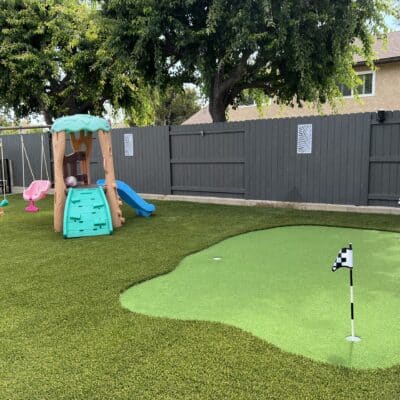 Backyard green, fringe, and cups
How the crew builds a putting green, in order
Layout, demo, gopher mesh
We paint the shape on the ground against the CAD drawing from your consultation. Sod, roots, and sprinkler heads come out. Gopher mesh goes over the graded soil; a tunnel under a green becomes a hump that changes the read on every putt.
Base, breaks, screed
Class 2 base rock goes down in lifts and is compacted hard. Breaks are shaped in the rock, not the turf: a rise here, a fall toward a cup there. The top is screeded smooth and compacted again. A ripple in the base is a ripple in the roll.
Cups, putting turf, fringe
Cup sleeves are set through the base where you picked. Putting turf is rolled out, cut to shape, seamed, and stretched so no wrinkle survives. Fringe is cut in around the outside and where a chipping zone meets the green.
Infill, roll, speed check
Sand infill is brushed in and rolled in passes until the ball runs at the speed you asked for. Then the walkthrough: we putt from every cup with you watching, mark anything that pulls or checks up, and fix it before the tools go back on the truck. The first roll is yours, and the flags go in last, with the site cleaned to the gate.
Turf, fringe, cups, and the choices that shape the green
Every green uses the same few parts. How much of each, and how they are arranged, is decided at the estimate.
Putting turf
Short pile, tight stitch, nylon or polypropylene yarn. Nylon runs faster; polypropylene is softer and slower. Colors run from bright green to natural brown tones across the four manufacturers we work with.
Fringe turf
A taller pile around the putting surface that reads as a mown collar. It stops a hot putt, gives you a lie for chips, and hides the change from green to planters or the paver patio many customers put beside it.
Cups, flags, chipping zones
One cup makes a practice green. Three or four make a course, with putts across the breaks between them. A chipping zone is a pad of fringe a few paces out, so you pitch from a real distance.
Size
Small greens fit a side yard and hold one or two cups. Larger golfing areas take most of a backyard and add fringe, a chipping pad, and length for a real lag putt.
Speed
Speed is set with infill. More sand rolled into the pile makes a firmer, faster surface; less runs slower and softer. We tune it on install day and can change it later.
What decides the cost, and what this climate adds to the job
No two greens cost the same. The number moves on the square footage of putting surface, how much fringe wraps it, the number of cups, how much shaping the base needs, whether there is a chipping zone, how the crew and the rock get into the yard, and what has to be demolished first. A green that replaces a lawn costs more than one on bare dirt.
The weather works in your favor. Putting turf needs no water, so the green stays green through the dry months and every watering rule. Full sun warms it; a rinse cools it. Gophers are the local hazard, so mesh goes under every green we build, and the base is graded so a winter storm drains through the backing and away from the house.
The turf comes from established manufacturers, with products backed by manufacturer warranties, and the work is done by a California licensed contractor, CSLB #1036018. On the day, expect bins for the old material, a plate compactor most of the morning, and a walkthrough with putters out before anyone leaves. Backyard turf for the rest of the yard goes in on the same visit and runs up to the fringe.
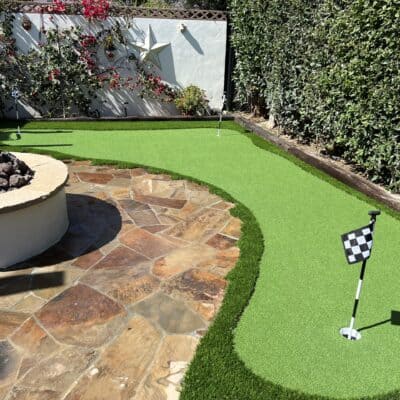 Brush, roll, keep the leaves off
Care, lifespan, and what a green asks of you
A few minutes a week. Keep leaves off the putting surface; a leaf that rots into the infill makes a soft spot in the infill. Brush the pile against the grain so it stands up, roll it if the speed has drifted, and rinse dust off in summer.
The surface is water-efficient and low maintenance by design. A base built this way should not need rebuilding, only a top-up of sand where the busiest line to the cup has packed down. Turf from our manufacturers is designed to last 15 to 20 years and carries its manufacturer warranty.
What people ask before they build a green
Less than you might think, and the honest answer comes from the drawing. At the estimate we draw the green on the ground and in CAD, with the cups and fringe in place, so you can see what fits before anything is ordered.
With the sand infill. We roll it in passes on install day and check the speed with a ball from every cup, and it can be reset later if you want it faster or slower.
Not once mesh is under the base. A gopher that tunnels up under a green hits wire; without it, one mound puts a hump in the line to the cup that no amount of rolling fixes.
Yes, and many customers do. A paver patio beside the green is built on the same visit, and the fringe turf is cut to meet the paver edge cleanly.
Show us the yard and bring your putter
We will measure the space, paint a shape on the ground, talk through cups, fringe, and breaks, and lay the putting turf samples side by side in your light. Send the form or call.